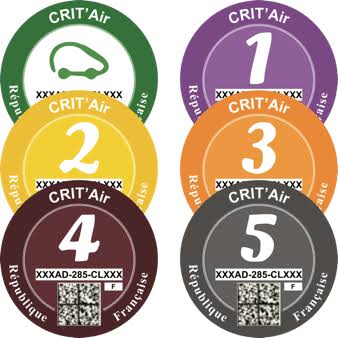
The Greater Paris Low-Emission Zone (Zone à Faibles Émissions or ZFE) represents one of Europe’s most ambitious clean air frameworks. Encompassing the territory inside the A86 ring motorway—spanning the City of Paris and 79 adjacent suburban municipalities—the regulation dictates vehicle access based on mandatory emissions categories, driving a widespread transition toward multimodal transit.
For daily commuters, regional workers, and cross-border travellers entering the Île-de-France region, attempting to drive into central Paris carries severe administrative friction. Pairing perimeter Park-and-Ride (Parc Relais) facilities with the high-frequency Metro, RER rail networks, and active micro-mobility systems offers the fastest, most reliable way to navigate the capital.
Understanding the Crit’Air Vignette Categories
Every motorized vehicle—including motorcycles, passenger cars, delivery vans, and heavy goods vehicles—must display an official Crit’Air vignette (air quality certificate) on the lower right-hand corner of the windscreen to enter the Greater Paris ZFE during restricted hours.
The classification assigns vehicles into numbered classes based on European emission standards (Euro norms) and powertrain type:
| Crit’Air Category | Powertrain & Euro Standards | Greater Paris ZFE Status |
|---|---|---|
| Crit’Air 0 (Green) | 100% Electric and Hydrogen vehicles | Permanent unrestricted access across all zones |
| Crit’Air 1 (Purple) | Plug-in Hybrids, Euro 5 & 6 Petrol (Jan 2011 onward) | Full access; compliant with current and future restrictions |
| Crit’Air 2 (Yellow) | Euro 4 Petrol (2006–2010), Euro 5 & 6 Diesel (2011 onward) | Permitted across the perimeter; slated for future phase-downs |
| Crit’Air 3 (Orange) | Euro 2 & 3 Petrol (1997–2005), Euro 4 Diesel (2006–2010) | Subject to active operating bans on weekdays inside the A86 |
| Crit’Air 4 (Burgundy) | Euro 3 Diesel (2001–2005) | Banned inside the A86 perimeter |
| Crit’Air 5 (Grey) | Euro 2 Diesel (1997–2000) | Banned inside the A86 perimeter |
| Unclassified | Vehicles registered prior to 1997 | Strictly prohibited across the entire metropolitan zone |
Geographic Boundaries & Enforcement Windows
The Greater Paris ZFE operates two distinct regulatory tiers that every intermodal commuter must recognize:
- Central Paris (Intramuros): Covers the entire area inside the Boulevard Périphérique ring road. Restrictions for Crit’Air 3, 4, 5, and unclassified vehicles apply Monday through Friday from 08:00 to 20:00 (excluding public holidays).
- Suburban Belt (Inside A86): Extends from the Boulevard Périphérique outwards to the A86 perimeter highway. The same weekday 08:00 to 20:00 operational window applies to heavy and light passenger vehicles. Note that driving directly on the A86 motorway itself remains exempt from sticker bans to facilitate orbital bypass journeys.
- Enforcement & Fines: Driving or parking a restricted or non-sticker-bearing vehicle within the perimeter triggers a Class 3 fine: €68 for passenger cars and light commercial vehicles, escalating to €135 for heavy goods vehicles and coaches. Automated camera-based enforcement (LPR) monitors the perimeter continuously.
The Multimodal Hub Strategy: Perimeter Park-and-Ride (P+R)
Rather than braving Parisian congestion charges, dense traffic lights, and parking fees averaging €4 to €6 per hour in outer arrondissements, the optimal commuter strategy involves parking at a dedicated Parc Relais adjacent to the A86 or Francilienne (N104) motorways and transferring to mass transit.
The primary perimeter transport corridors include:
- North / North-East (A1 / A3 Corridors): Terminus hubs at Saint-Denis Université (Metro Line 13) or Roissypole / Aulnay-sous-Bois provide direct RER B links into Châtelet–Les Halles in under 25 minutes.
- East (A4 Corridor): Hubs around Val de Fontenay or Noisy-le-Grand connect directly to RER A, the highest-capacity commuter rail line in Europe, delivering passengers straight to Nation and Gare de Lyon.
- South (A6 / A10 Corridors): Stations at Massy-Palaiseau offer multi-line interchanges between RER B, RER C, and regional bus corridors, completely avoiding the southern motorway bottleneck.
- West (A13 / A14 Corridors): Commuters park around Saint-Germain-en-Laye or Poissy to take the RER A directly into the central business district at La Défense.
Ticketing & Transit Integration: Navigo vs. Contactless
The Île-de-France Mobilités transit system has streamlined digital ticketing, making multimodal connections straightforward:
- Navigo Liberté+: For regular regional commuters, this pay-as-you-go card debits your bank account the following month based on actual usage, providing discounted single-journey rates and free transfers between Metro, buses, and trams.
- Navigo Easy: A reloadable plastic smartcard designed to replace cardboard ticket carnets. It stores digital Ticket t+ passes and daily regional passes, instantly loaded via smartphone NFC.
- Smartphone Digital Passes: You can load single tickets, day passes (Navigo Jour), and weekly passes directly onto iPhone and Android wallets without purchasing a physical smartcard.
Last-Mile Navigation: The Vélib’ Métropole Network
Once you exit the Metro or RER station, public bike-share forms the backbone of last-mile transit. Vélib’ Métropole operates over 1,400 docking stations across Paris and 55 surrounding suburban towns, managing more than 20,000 bicycles:
- Green Bikes (Mechanical): Ideal for flat crossings along the Seine river corridor and short hops across the central arrondissements.
- Blue Bikes (Electric Assist): Feature a 45 km battery range, allowing rapid crossing of the city or climbing elevated outer districts like Montmartre and Belleville without sweating in business attire.
- Coronapistes Infrastructure: Paris has converted major arterial routes—notably Rue de Rivoli and the Boulevard Saint-Michel—into protected, two-way cycle expressways, making bike transit significantly faster than surface taxis during peak morning hours.
Commuter Checklist for Greater Paris
- Order Your Vignette Early: Buy solely through the official French government portal (certificat-air.gouv.fr) for €4.61 delivered. Avoid fraudulent third-party intermediary websites charging €30+.
- Affix Correctly: Place the sticker inside your windscreen on the lower right passenger side; camera gantries read this angle automatically.
- Map Your Metro Hub: Check Île-de-France Mobilités real-time journey planners before departing to identify stations with free or discounted P+R bays linked to Navigo passes.
- Carry Cycling Gear: If relying on blue Vélib’ e-bikes for the final leg, keep a folding helmet and a high-visibility waterproof shell in your daily commuter pack.