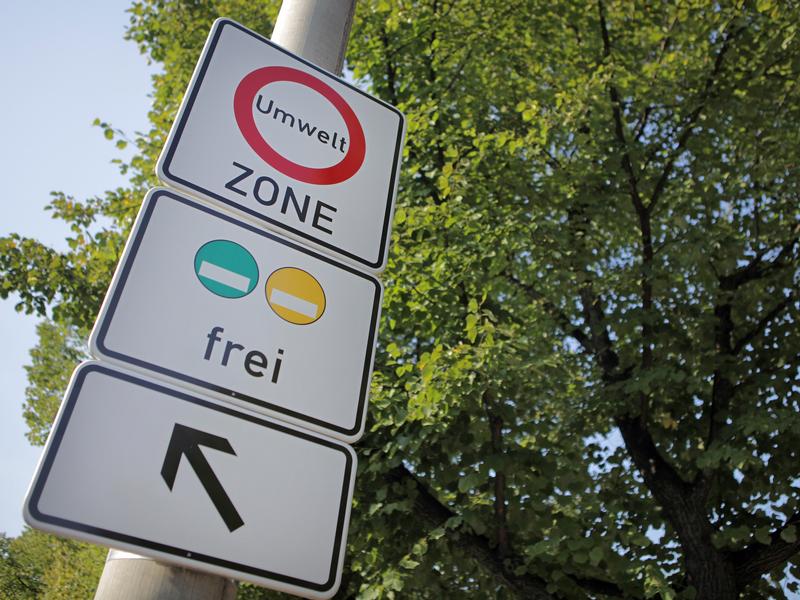
Berlin’s low-emission framework—the Umweltzone—was one of the pioneering municipal clean air initiatives in Europe. Established to curb toxic nitrogen dioxide ($NO_2$) and particulate concentrations, the zone mirrors the boundary of the historic Hundekopf (“Dog’s Head”): the elevated orbital railway known as the S-Bahn Ring (Ringbahn lines S41 and S42). Inside this 88-square-kilometre metropolitan core, motorized road transit is restricted by strict environmental badge mandates.
For daily commuters traveling from Brandenburg, Potsdam, or the outer suburban rings, driving through radial bottlenecks like the AVUS (A115) or the A100 city motorway often ends in gridlock. By pairing orbital Park-and-Ride (P+R) stations with the city’s dense rail grid, the nationwide Deutschlandticket regional pass, and active micro-mobility along wide cycle boulevards, travelers can bypass vehicle restrictions entirely.
The Green Badge Mandate: Umweltplakette Rules
To operate or park any four-wheeled motorized vehicle inside the Berlin Ringbahn, it must display an official Green Environmental Badge (Grüne Plakette / Schadstoffgruppe 4) affixed to the inside lower-right corner of the windscreen.
Unlike flexible municipal zones in other countries that utilize tiered, sliding-scale access, Berlin enforces a single, binary compliance threshold:
| Vehicle Classification | Minimum Euro Standard | Berlin Umweltzone Eligibility |
|---|---|---|
| Petrol / Gasoline Passenger Cars | Euro 1 with closed-loop catalytic converter (since 1993) | Eligible for Green Badge (Unrestricted entry) |
| Diesel Passenger Cars & Light Vans | Euro 4 (or Euro 3 retrofitted with certified DPF) | Eligible for Green Badge (Unrestricted entry) |
| Modern Diesel (Euro 5 & Euro 6) | Euro 5 / Euro 6 / Euro 6d | Eligible for Green Badge (Unrestricted entry) |
| Electric Vehicles (BEV) & Fuel Cell | Zero tailpipe emission | Requires Green Badge (or foreign EV blue E-Plakette) |
| Older Diesel (Euro 1, 2, or standard 3) | Pre-2006 without particulate filter | Strictly Banned from entering the S-Bahn Ring |
Enforcement Note: Entering the Umweltzone without a valid, legible Green Badge—even in an ultra-clean modern diesel or electric car—results in a statutory €100 fine. Foreign-registered vehicles are not exempt; drivers must purchase an official badge via local technical testing centres (TÜV, DEKRA) or municipal citizen offices before entering the perimeter.
Strategic Commuter Interchanges: Outer S-Bahn P+R Hubs
Because finding all-day parking inside the Ringbahn is either restricted by strict municipal parking management (Parkraumbewirtschaftung, costing €1.00 to €3.00 per hour) or reserved for residents, regional commuters save time and budget by utilizing perimeter Park-and-Ride hubs along the suburban S-Bahn corridors.
To project your potential savings on fuel, parking fees, and vehicle depreciation by switching to a multimodal commute, model your numbers in our Commute Cost & Carbon Calculator.
Primary Orbital Transit Gateways:
- South-West (Potsdam / A115 Corridor): Stations such as Wannsee or Grunewald allow commuters from Brandenburg to park before hitting the A100 urban bottleneck, boarding the S7 directly to Zoologischer Garten, Hauptbahnhof, and Alexanderplatz.
- South / South-East (A113 / BER Corridor): Hubs at Schöneweide or Adlershof link the technology clusters directly with the S-Bahn Ring (S41/S42, S8, S9).
- East (A10 / B1 Corridor): Commuters approaching from the east utilize major multi-level parking decks at Erkner, Hoppegarten, or Mahlsdorf to board the high-frequency S5 line straight into the city centre.
- North / North-West (A111 / A10 Corridor): Facilities at Frohnau, Tegel, or Bernau avoid northern inbound traffic jams via the S1 and S2 trunk lines.
BVG & S-Bahn Carriage Regulations: Bikes vs. E-Scooters
Berlin is widely regarded as one of Europe’s most cycle-friendly capitals, with wide sidewalks and dedicated cycle paths (Radwege). However, carrying personal hardware on public transit involves specific ticketing and safety rules enforced by the BVG (U-Bahn, trams, buses) and S-Bahn Berlin:
1. Full-Size Bicycles
Non-folding standard bicycles require a dedicated Fahrradkarte (single ticket or monthly bicycle pass) in addition to your personal ticket. Bikes are permitted inside clearly marked multi-purpose compartments (Mehrzweckabteile) on the S-Bahn and U-Bahn, provided there is adequate room for wheelchairs and prams, which always take legal priority. Bicycles are strictly prohibited on BVG municipal buses.
2. Folding Bikes & Micro-Mobility
As detailed in our folding e-bikes evaluation guide, fully collapsed folding bikes count as regular hand luggage (Handgepäck). They travel 100% free of charge across all BVG and S-Bahn services at all hours without requiring a bicycle supplementary ticket, as long as they remain folded and stowed securely.
For wet-weather riders navigating Berlin’s winter slush and grit along the Spree river trails, choosing an enclosed setup—such as those compared in our belt drive vs. chain breakdown—eliminates chain rust and keeps station platforms clean.
3. E-Scooter (E-Tretroller) Restrictions
Following battery fire safety directives adopted across multiple European transit operators, privately owned and shared stand-up electric kick-scooters are currently banned from subterranean BVG U-Bahn carriages and underground stations. Commuters relying on last-mile electric propulsion should opt for certified folding e-bikes or public municipal bike shares instead.
Last-Mile Options: Nextbike and Jelbi Hubs
For commuters who leave personal bicycles at outer park-and-ride stations, Berlin’s mobility integration platform, Jelbi (developed by the BVG), clusters car-sharing, shared e-mopeds, and public bike-share docking directly outside station exits.
- Nextbike (BVG Bike): Operating thousands of dockless and station-based bicycles across the capital. Deutschlandticket holders and BVG subscription members receive free 30-minute ride allocations on each trip, making short hops from the station to the office completely cost-free.
- Protected Cycling Infrastructure: Key east-west and north-south cycling express routes—such as the segregated lanes along Karl-Marx-Allee, Torstraße, and the Hasenheide corridor—feature wide green-carpet asphalt and dedicated cyclist traffic light phases, separating active riders from motorized vehicle lanes.
Commuter Action Plan for Berlin Entry
- Secure Your Green Badge Early: If driving a foreign or rental vehicle, acquire an official Grüne Plakette online or at any vehicle test station beforehand. Windscreen display is mandatory even when parked on public streets inside the Ringbahn.
- Leverage the Deutschlandticket: For €58 per month, the subscription covers every S-Bahn, U-Bahn, regional train (RE/RB), tram, and ferry throughout Berlin and Brandenburg.
- Avoid the A100 Funnel: Ring-road construction zones cause severe delays during morning and evening rush hours; transfer to the S-Bahn Ring at the outer orbital junctions.
- Protect Yourself in Low-Light Commuting: Berlin’s winter mornings and early dusks demand high visibility along unlit park corridors; equip yourself with elevated illumination, such as the active lighting evaluated in our smart commuter helmets guide.