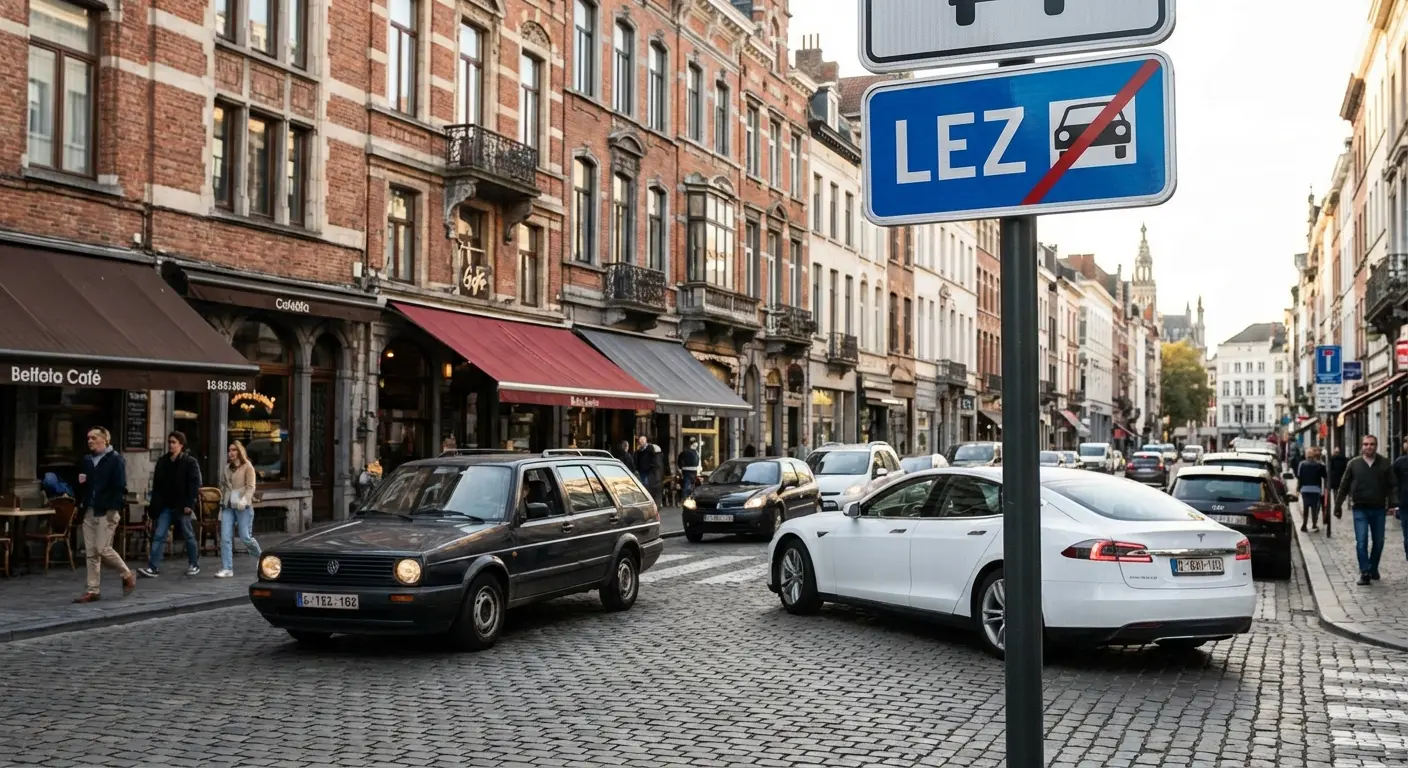
As the administrative heart of the European Union, the Brussels-Capital Region enforces an ambitious metropolitan clean air initiative: the Brussels Low Emission Zone (LEZ). Covering all 19 municipalities within the regional boundary—an area spanning more than 160 square kilometres—the zone restricts high-polluting internal combustion engines to slash nitrogen dioxide ($NO_2$) concentrations and fine particulates in dense urban neighbourhoods.
For cross-border workers and daily commuters arriving from Flanders, Wallonia, or neighbouring EU member states, driving directly into central Brussels entails heavy congestion along the notoriously congested R0 orbital motorway. By pairing strategic perimeter Park-and-Ride (P+R) terminals with the integrated STIB/MIVB transit network, the multi-operator Brupass system, and protected cycle expressways, commuters can traverse the capital cleanly and cost-effectively.
Brussels LEZ: Boundaries, Operational Window & ANPR Enforcement
The Brussels Low Emission Zone operates under an automated, camera-enforced structure that requires no physical windscreen stickers. Instead, more than 300 stationary Automatic Number Plate Recognition (ANPR) cameras cross-reference vehicle registration marks against the national vehicle licensing database.
- Geographic Boundary: Encompasses all 19 municipalities of the Brussels-Capital Region (including Brussels City, Ixelles, Schaerbeek, Anderlecht, and Saint-Gilles).
- Exempted Corridors: The Ring R0 orbital motorway is excluded from the LEZ to permit through-traffic. Certain access roads linking the R0 to peripheral transit hubs—such as the route leading directly to the P+R Crainhem—are also exempt.
- Operating Schedule: The LEZ applies 24 hours a day, 7 days a week, 365 days a year. There are no weekend or off-peak enforcement holidays.
- Fines & Penalties: Entering the zone in a non-compliant vehicle triggers an administrative fine of €350. A single fine covers a three-month transitional grace window; subsequent violations after three months result in additional €350 penalties.
Vehicle Compliance Matrix
Access eligibility is tied directly to the vehicle’s fuel type and European emission standard (Euro norm), as indicated on the vehicle registration certificate (field V.9):
| Powertrain Classification | Minimum Euro Standard Required | Brussels Capital Region Access Status |
|---|---|---|
| 100% Electric & Hydrogen (FCEV) | Zero emission | Permanent unrestricted access across all 19 municipalities |
| Petrol, CNG, LPG & Hybrid | Euro 2 or higher (typically registered 1997 onward) | Full access permitted |
| Diesel (Passenger Cars & Light Vans) | Euro 5 or higher (Euro 5a/5b, Euro 6) | Permitted; Euro 5 models subject to scheduled progressive bans |
| Older Diesel (Euro 1, 2, 3, 4) | Pre-September 2011 standard diesels | Strictly Banned from entering the region |
| Two-Wheelers & Scooters | Class L1 and L2 mopeds | Currently exempt from regional access bans |
Mandatory Rule for Foreign-Registered Vehicles: All motor vehicles registered outside Belgium (including company cars and visitors from France, Germany, or the Netherlands) must be registered online via the official Brussels LEZ platform (lez.brussels) before entering the region. Registration is free of charge and remains valid for three years. Driving a foreign vehicle into Brussels without prior registration triggers an automatic €150 administrative fine, even if the engine meets the latest Euro 6 emissions standard.
The Day Pass Mechanism (Emergency Access)
For drivers with non-compliant vehicles needing occasional entry, the Brussels administration allows the purchase of an individual LEZ Day Pass. A day pass costs €35 per calendar day and can be purchased for a maximum of 24 days per calendar year per vehicle. Day passes must be bought online prior to entering the zone, or by midnight on the day following the journey.
For regular commuters, relying on day passes is financially unsustainable. Comparing your actual monthly motoring expenditure against integrated mass transit options can be modeled in our Commute Cost & Carbon Calculator.
Strategic Multimodal Hubs: Perimeter Park-and-Ride (P+R)
Because street parking within inner Brussels is tightly regulated through municipal red, orange, and blue ticketing zones (often capped at two hours and costing up to €3.50/hour), the optimal strategy involves parking outside the dense central core and transferring to rapid mass transit:
- P+R Crainhem (Kraainem): Situated immediately off the E40/R0 junction in the east. Directly connects to Metro Line 1, reaching Schuman (EU Quarter) and Central Station within 18 minutes. Accessible without entering the restricted LEZ surface streets.
- P+R Ceria / Coovi: Located in the south-west at the Anderlecht R0 interchange. A multi-storey facility offering 1,300 parking bays, with direct interchange to Metro Line 5 (connecting to Gare du Midi and Arts-Loi).
- P+R Heysel (Parking T): Positioned in the north near the A12/Ring intersection, providing surface transfers to Metro Line 6 and high-frequency tram corridors (Lines 7 and 93).
- P+R Roodebeek: Located at the Woluwe interchange, serving as a primary multimodal gateway for regional De Lijn and TEC express commuter buses, alongside Metro Line 1.
STIB/MIVB, Brupass & Regional Rail Ticketing
The Brussels public transport operator (STIB/MIVB) works alongside Belgian National Railways (SNCB/NMBS) and regional bus operators (De Lijn in Flanders, TEC in Wallonia) through integrated ticketing frameworks:
- Brupass & Brupass XL: These unified tickets allow commuters to use all transport operators within the Brussels perimeter on a single fare. Brupass covers the 19 municipalities, while Brupass XL extends coverage to an 11.5 km radial perimeter around Brussels, encompassing major suburban rail commuter stations.
- EMV Contactless Tapping: For occasional travelers, all STIB/MIVB metro gates, buses, and trams feature contactless NFC card readers. Passengers tap a debit/credit card or smartphone on entry, benefiting from automated daily price capping.
- Suburban S-Train (S-Trein): Operates as the high-speed regional rail backbone, linking outer Brabant towns directly with core interchanges like Bruxelles-Schuman, Bruxelles-Luxembourg, and Bruxelles-Central. Like Germany’s integrated transit approaches detailed in our European rail pass guide, Brussels continues to harmonize multimodal tariffs across regional borders.
Last-Mile Active Mobility: The Cyclo & Villo! Networks
Brussels’ municipal authorities have reallocated significant road space to cycle infrastructure, designated as Cyclostrades / Fietssnelwegen (numbered cycling expressways linking Flemish and Walloon corridors directly into the city centre).
Transit Carriage Rules for Bicycles
- Folding Bicycles: Fully collapsed folding bikes are treated as hand luggage and travel 100% free of charge at all times across STIB/MIVB metro, trams, and buses. See our comprehensive benchmark on folding e-bikes for train commuters to choose a setup optimized for daily carriage.
- Standard Bicycles: Non-folding bikes are permitted only on low-floor Metro trains and low-floor trams outside morning and evening rush hours (strictly banned between 07:00–09:00 and 16:30–18:30 on weekdays).
- Villo! Public Bike Share: Operates hundreds of automated docking stations across the 19 municipalities, offering mechanical cycles and blue e-Villo! battery-pack rentals to conquer Brussels’ undulating topography (such as the climb from the Senne valley to the upper EU plateau).
Because Brussels experiences persistent Atlantic drizzle and salted winter roads, daily bike commuters benefit significantly from grease-free drivetrains—an advantage broken down in our technical comparison of belt drive vs. chain city bikes.
Brussels Commuter Action Plan
- Complete Free Foreign Registration: Ensure any non-Belgian passenger car or van is registered at lez.brussels at least 24 hours prior to travel to avoid the automated €150 fine.
- Target Peripheral P+R Hubs: Use P+R Crainhem or P+R Ceria to leave your car on the regional perimeter, taking direct metro lines into the historic centre or the European Quarter.
- Opt for Brupass XL for Multi-Zone Trips: If commuting from towns immediately bordering the capital (such as Vilvoorde, Zaventem, or Waterloo), a Brupass XL subscription saves hundreds of euros annually over disconnected individual rail and metro passes.
- Equip for Mixed Visibility: Wet cobblestones and unlit park thoroughfares through the Bois de la Cambre or along the Canal demand elevated illumination; review our guide on smart commuter helmets with active lighting before riding during autumn and winter mornings.